European design
Handleless European Kitchen Cabinets: How Do They Open?
Recessed grips, mechanical push-to-open and powered opening can create a clean cabinet front. Here is how to choose between them for an American home.
By NOBU Editorial ·
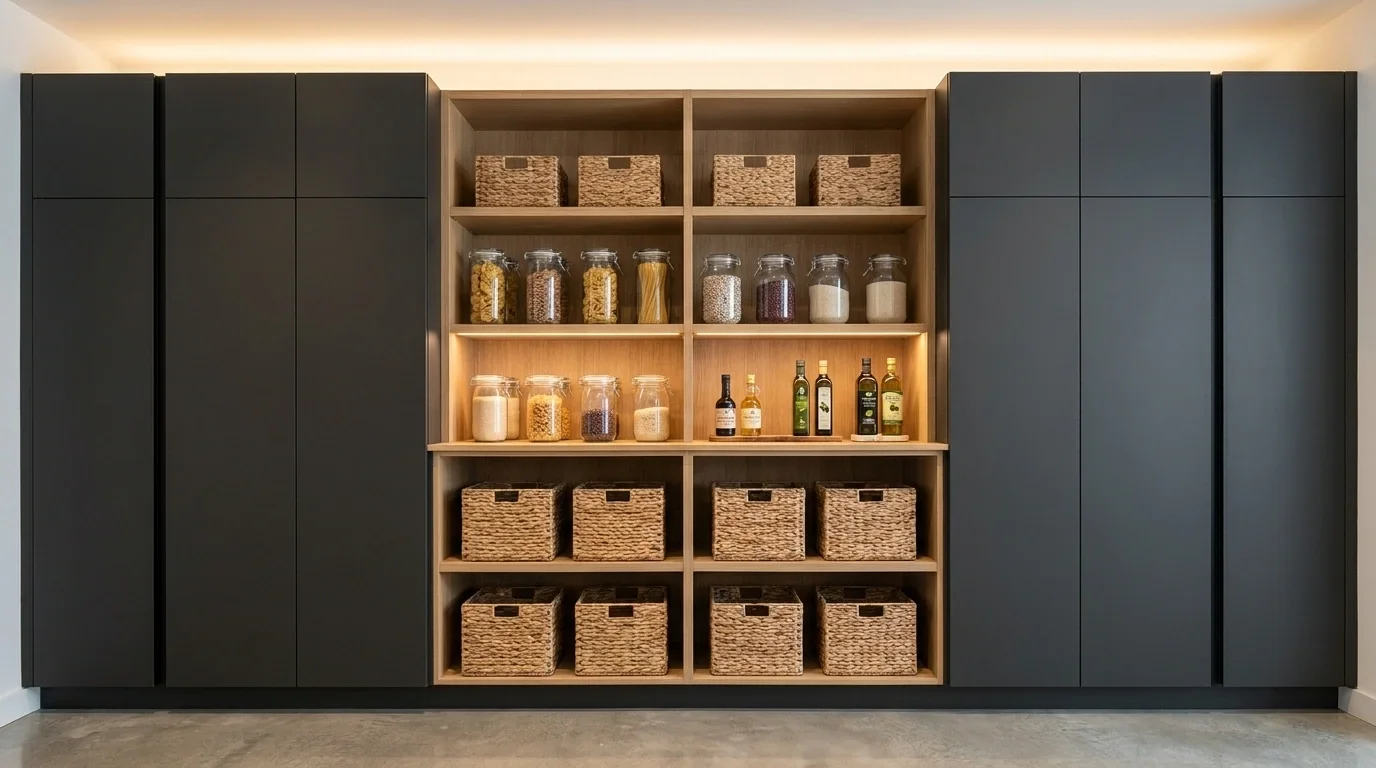
Handleless European kitchen cabinets generally open through a recessed grip, a mechanical push-to-open mechanism or an electrically assisted system. Those approaches can produce a similarly quiet elevation, but they feel different in use. Choosing the right one starts with the opening action, rather than the photograph of the finished kitchen.
Removing visible pulls is a useful way to emphasize the relationship between cabinet fronts and the architecture around them. It does not remove the need for a comfortable place to grip, a reliable trigger or carefully coordinated clearances. A flat-looking front alone cannot tell you which mechanism sits behind it.
1. Recessed grips: a place for the hand
A recessed grip creates access behind an edge of the front or within a channel. You still pull the cabinet open by hand; the grip is incorporated into the design instead of appearing as a separate projecting handle.
Gola profile: the channel stays with the cabinet
A Gola arrangement uses a separate aluminum profile fixed to the cabinet carcass. The channel provides finger access behind a plain drawer front. When the drawer is pulled open, the profile stays with the cabinet; it is not a handle attached to the moving front.

Integrated J-pull: the grip is part of the front
An integrated J-pull is shaped into the door or drawer front itself. Its concave, hook-like recess creates a place for the fingers, and the grip moves together with the front. This routed pocket is different from an aluminum Gola rail, even when a rail is described as having a J-shaped section.

A 45-degree beveled upper edge: a straight angled grip
A beveled grip uses a straight angled cut along the upper edge of the drawer front. In the 45-degree example below, the outside edge is higher and the surface slopes down toward the drawer interior. It is a planar cut rather than the curved pocket of an integrated J-pull. The thin upper line is shown in the main view; the side section makes the angle visible. The proposed cabinetry must leave access for the fingers behind that edge.

LEICHT's published design lines illustrate that handleless design can include a concealed handhold. Its CONTINO C1 description separates a top drawer reached from behind the front from lower drawers operated mechanically or electrically. This is a useful reminder that one elevation can combine different opening methods.
When reviewing a recessed-grip proposal, ask to see both the front elevation and the section through the gripping point. Consider whether the opening is comfortable for the people using the kitchen, and whether the grip remains easy to reach beside an appliance or at the end of a run. A continuous-looking line should make sense at those junctions, too.
2. Mechanical push-to-open: pressure activates the front
A mechanical push-to-open system lets you activate an opening mechanism by pressing the cabinet front. The exact action and compatible components depend on the specified product; push-to-open should not be treated as one universal fitting.
For example, Blum describes TIP-ON BLUMOTION as a mechanical drawer-opening system combined with soft closing. That is a specific product combination, rather than evidence that every push latch includes the same closing behavior. Ask the cabinet team to identify the actual system for each door or drawer and explain how it opens and closes.
Try a representative sample rather than judging the mechanism only from a small display door. Notice where you naturally press, whether the opening action feels intuitive and how you guide the drawer back to its closed position. These are practical observations to discuss, not a substitute for the manufacturer's requirements.
3. Powered opening: electrical assistance
Electrically assisted opening uses a different mechanism to initiate movement. Blum's SERVO-DRIVE, for instance, is an electrical opening-support system offered for kitchen applications including drawers and lift systems. Its published information also explains that equipped cabinets can be opened manually during a power outage.
That example should not become an assumption about every powered product. If electrical assistance is proposed, confirm the specific application, power provisions, manual operation and service access with the responsible team. Coordinate those needs while the cabinetry and electrical information can still be reviewed together.
The design question is whether the assistance serves a useful routine in your home. A particular frequently used cabinet may justify a different opening action from the surrounding storage without changing the overall visual direction.
Adapt the European idea to the American household
The most convincing translation of a European design approach is a kitchen that looks composed and suits the way its owners live. An American household's appliances, storage habits and patterns of cooking should shape the details, even when the inspiration is a restrained European elevation.
Review representative locations: a tall pantry, a low drawer, a waste cabinet and storage beside an appliance. Ask the people who will use them to try the proposed action. A preference for a physical grip in one location does not automatically require visible pulls throughout the kitchen.
Also examine the front as a surface you will touch. Review the selected finish and its care instructions rather than assuming that all matte, wood or painted fronts behave alike. An opening choice and a surface choice should work together.
Questions to settle before approving a handleless kitchen
- Which opening method is specified for each cabinet type?
- Where does the hand grip or press in normal use?
- What clearances and front details does that system require?
- Have appliance interfaces and adjacent fronts been coordinated?
- If powered hardware is included, who coordinates power and future access?
- Can the intended users try a representative example before approval?
These questions turn a general preference for clean lines into an understandable specification. They also make it easier to compare proposals that look similar but use different details.
NOBU's interest in modern European design is about bringing those considered decisions into American living spaces. Start with the visual direction, then examine how the furniture will be opened, used and maintained. The strongest handleless design is one whose everyday operation feels as resolved as its appearance.
Sources
Product examples explain different mechanisms; they do not imply that a named system is included in every NOBU project. Confirm the agreed hardware specification for your own cabinetry.
Blum USA — TIP-ON BLUMOTION
https://www.blum.com/us/en/products/motion-technologies/tip-on-blumotion/overview/
Blum USA — SERVO-DRIVE
https://www.blum.com/us/en/products/motion-technologies/servo-drive/servo-drive-pullouts/overview/
LEICHT — Design lines
https://www.leicht.partners/oxfordkitchens/asthetik/gestaltungslinien/
Scilm America — Gola handleless profiles and technical sections
https://scilmamerica.com/gola-profile.html
DIY Kitchens — Integrated J-profile doors
https://advice.diy-kitchens.com/customer-questions/handleless-kitchen-design-ideas/
TM Italia — Handleless straight and inclined edge designs
https://tmitalia.it/en/handleless-kitchens/